Welcome to Our Orthopedic Clinic in Pakistan!
Everyone dealing with chronic joint pain experiences the moment when one feels that everything in life is based on limitations. Each movement hurts, and every step seems exhausting. This is how joint issues usually affect not just the physical state of a person but also the psychological one. With the worsening of symptoms, individuals turn to search for ways to treat their condition and regain their previous quality of life.
In cases when medication, physiotherapy sessions, injections, and physical activity do not bring any positive changes, considering surgical treatment is the only option left.
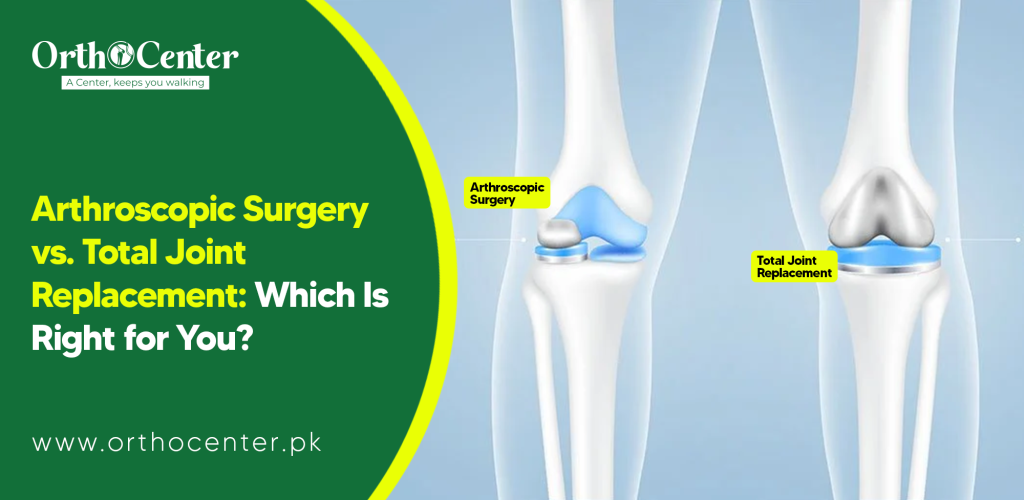
The two procedures that often come into consideration are arthroscopy surgery and joint replacement. Despite the fact that both operations improve patients’ condition, their nature differs greatly. An accomplished and committed surgeon like Dr Ahmed Shoaib at Orthocenter can educate his patients about the medical facts about the options.

His keen focus on advanced procedures allows him to deliver the best health care to his patients. The current blog will provide information on the dissimilarities between arthroscopic and total joint replacement surgeries, along with mentioning their benefits, possible side effects and expected results.
Among the latest advances, arthroscopic surgery is a big breakthrough. It is a minimally invasive surgery that specialises in precise evaluation and treating joint problems. A surgeon makes small incisions and inserts an instrument, an arthroscope, to look inside the joint. Pictures from the arthroscope are displayed on a television screen and allow the surgeon to repair the joint. As surgeons get real-time information about the joint status at a micro level, diagnosis and treatment by experienced Arthroscopic Surgeons are performed at a much more advanced and precise level.
Arthroscopy is usually done on the:
Commonly, arthroscopy can be recommended for:
The nature of the procedure is foundational to all the advantages of arthroscopic surgery. Below is a shortlist of the major benefits of the procedure
Even though arthroscopy has a number of benefits, it cannot be used on all patients.
Total joint replacement, or arthroplasty, is a major surgery for joint issues. As the name demonstrates, the procedure is about removing the original joint and placing an artificial one. The new artificial joints may be of metal, plastic, or ceramic.
Common sites of joint replacement surgeries include:
Indications for total joint replacement surgeries include:
In the operation, the diseased cartilage and bone tissues will be removed to resume a pain-free movement and to allow artificial joints to work perfectly.
Total joint replacement surgery may make a tremendous difference in improving the lives of patients with extensive joint deterioration. Here is a brief description of how
Almost all patients notice significant improvements in their constant pain after surgery.
Patients are able to walk again and move around easily with ease.
The average lifespan of an implant today is 15 to 25 years.
Patients are once again able to live independently and participate in the activities they gave up due to pain. It overall upgrades their quality of life.
Hip replacement and knee replacement surgeries are one of the most successful medical procedures today. Thus, the success rate of the procedure is high on the graph.
Exceptions are always there. While being very successful, joint replacement surgery has its disadvantages and risks.
Extended Recovery Period:
Recovery time can be quite long, especially with knee and hip replacement surgeries.
Hospitalisation: Patients need to spend some time in the hospital post-operation; however, there is an increased trend toward allowing patients to go home the day of the procedure. Yet, everything is circumstantial.
Complications can involve:
Activities involving high impact, such as running and jumping, might be restricted due to the risk associated with wearing down the new joint.
Artificial joints can fail to function over time and thus require replacement surgery.
Expert care with the availability of advanced procedures is a step away: Visit Orthocenter
Meet Dr Ahmed Shoaib for precise procedure selection, effortless recovery, and lasting joint stability
The other factor which determines whether or not one will undergo a certain procedure is cost.
Since arthroscopy is a minimally invasive process and does not require hospitalization, it is usually cheaper. If, however, symptoms persist, then the patient will require another surgery, hence increasing costs in the long term. On average, patients are supposed to have an expense of PKR 150, 000 to 300,000.
While joint replacement is costlier, it offers long-term relief, thus saving money on future costs. But on the one hand, a possible hospital stay, expenditure on implants, and recovery requirements increase the overall cost. In Pakistan, it could range from PKR 400,000 to PKR 1,200,000.
Consider arthroscopy if you
Go for joint replacement surgery if you are experiencing:
| Factor | Arthroscopy Surgery | Joint Replacement Surgery |
|---|---|---|
| Procedure Type | Minimally invasive | Major surgery |
| Purpose | Repairing of damaged tissues | Replacement of the entire joint |
| Hospital Stay | Injuries and mild joint damage | Severe arthritis and degeneration |
| Longevity | May not be permanent | Long lasting |
| Cost | PKR 150,000 to 300,000 | PKR 400,000 to 1,200,000 |
| Recovery | Few days | Several months |
| Best for | Injuries and mild joint damage, often young adults | Severe arthritis and degeneration, in most cases for older adults |
In the end, joints are precious to preserve in terms of their health and functioning. Thanks to the advances in orthopedic surgeries, experienced Orthopedic Surgeons can now offer a wide range of treatment choices tailored to the individualized needs of each patient.
The decision to have either arthroscopic surgery or total joint replacement, which are highly impactful procedures, could be challenging. Different criteria, such as age, lifestyle, severity of joint damage, and health status, need consideration in picking the one.
The use of arthroscopic surgery is preferable when dealing with joint injury and joint problems at an early stage, without destroying the joint. The process takes a shorter time compared to total joint replacement, and there is no need to reconstruct the joint.
Total joint replacement surgery is more advisable for people with advanced joint conditions. Even though the patient takes a considerable amount of time to recover, the results are more durable. All of the above, along with the clinical judgment of a well-rounded orthopedic surgeon like Dr. Ahmed Shoaib at Ortho Center, matters a lot. His determination to upgrade his patients’ quality of life sets him apart from the rest of the experts. Thus, approaching the right specialist and making an informed decision ensures the longevity of your joints’ health.
WhatsApp Us
