Welcome to Our Orthopedic Clinic in Pakistan!
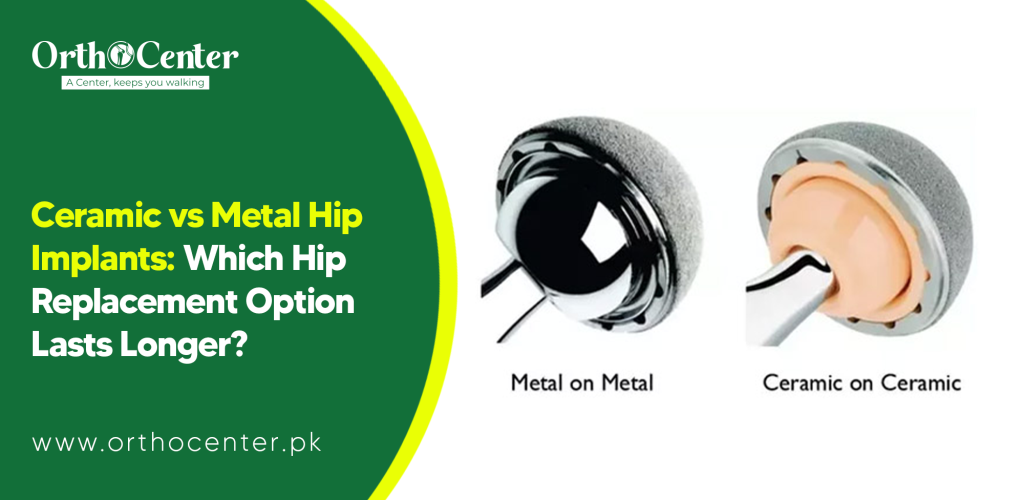
Indeed, no one deserves to bear pain while taking a single step for routine tasks. This is the way hip issues impact your mobility and comfort. Presently, many individuals have benefited from hip replacement surgeries and regained the ability to do routine tasks with ease. With new advancements in orthopedic procedures, there is now a variety of artificial hips available to ensure longevity and efficiency. As options are extended, so is the confusion. The most common question that arises before undergoing hip replacement surgery is, which type of hip joint will last longer – ceramic or metal?
In addition to being lightweight and having a higher wear resistance than metal, ceramic joints are less likely to breakage. However, metal implants are more durable than ceramic ones. Moreover, they have a lower risk of fracturing. Dr Ahmed Shoaib from Orthocenter is committed to providing quality hip joint replacement services through personalized treatment plans. Using contemporary methods of replacing hips, he ensures his clients live more comfortably and pain-free lives.
This article will highlight the major benefits and risks of ceramic vs metal hip implants to enable you to make wise decisions as per your needs.
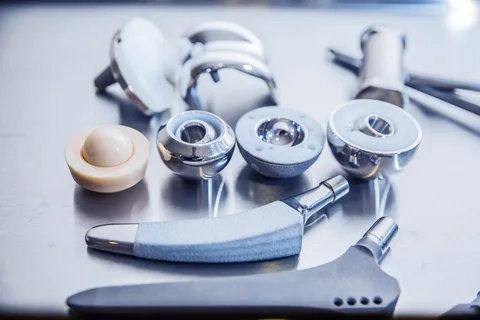
As artificial hips have to perform all the functions that natural joints do, their structure mimics the originals. These implants are generally made up of two primary pieces:
These can either be constructed using ceramic material, metals, or polyethene (plastic used for medical purposes). Some of the most common bearing materials are:
Among the most commonly used today are the ceramic and highly cross-linked polyethene combinations.
Though the news that the original joint is replaceable brings great relief. Yet, the worth of natural organs is unchallengeable. A hip implant is not a permanently installed device. Friction from continuous movement wears down the ball and socket, which in turn leads to numerous complications. Among these, inflammation, bone degradation, loosening of the artificial joint, and finally the need for further operations come frequently in discussion.
In cases of younger and more active patients, the lifetime of an implant becomes an issue. It’s expected they might live longer than their initial joint replacement. The life expectancy of modern implants ranges from 15 to 25 years, while some may last even longer in various scenarios. The right choice becomes more critical in this regard so that they can accompany you for an extended period. Otherwise, there could be a need for more than one revision surgery.
These implants employ exceptionally hard materials that generate minimal amounts of friction during movements. In addition, this material can be used as either the ball or the socket liner material.
For the following reasons, people prefer ceramic implants.
The best quality of ceramic implants is wear resistance. Ceramic surfaces are smoother than metal components, hence creating less friction and generating no wear debris.
Recent studies indicate that ceramic-on-ceramic joints typically wear less than conventional metal-on-polyethene joints.
Due to minimal wear debris production, ceramic implants tend to be more durable and therefore could last longer, particularly among younger patients.
According to one of the longest-term comparative investigations of ceramic-on-ceramic joints with metal-on-cross-linked polyethene joints, survival without component replacement is 15 years. It is indeed a reasonable period for patients of all ages, whether younger or older adults.
In contrast to metal-on-metal implants, ceramic does not generate any metal ions in the body. Experts count it as a big advantage because metal ions may cause tissue reactions and inflammation in some cases.
Orthopaedic surgeons agree about using ceramic implants among younger patients because of their longevity and wear resistance qualities. Hence, it would not be wrong to say that the suitability of these implants is higher for the youth.
Even though there are a number of advantages associated with ceramic implants, they are not entirely flawless.
Although contemporary ceramics are far more advanced than those used before, the possibility that the implant might fracture does exist. The fact that ceramics are somewhat brittle materials supports the statement.
The most common side effect of ceramic-on-ceramic hip replacement surgery is that the patients may hear squeaking noises from time to time while moving around. Even though it is not particularly dangerous, it may prove to be disturbing to some people.
Cost can never be an exception while discussing the detrimental factors. These implant types are costly, in general opinion.
Being Full of Life Is To Move Freely: Visit Orthocenter For Expert Joint Replacement
Meet Dr. Ahmed Shoaib To Bring Back Comfort In Every Step
Most metal implants consist of cobalt chromium or titanium alloys. The contemporary design is that of a metal femoral head with highly cross-linked polyethene.
Metal hip implants are beneficial for the following reasons.
Metal on polyethene implants have been in use for several decades. There is considerable expertise regarding these implants, and multiple studies support their longevity. Additionally, recent advances in highly cross-linked polyethene have substantially increased implant longevity.
Metal implants are extremely durable and do not tend to break like ceramic materials. They are resistant to stress and can withstand impacts and stress.
Metal implants are relatively affordable but have outstanding clinical performance.
The following risks are more likely associated with metal hip implants.
Metal on Polyethylene articulations have been known to cause wear particles. In consequence, these might cause bone resorption and the prosthesis to loosen over time.
However, the introduction of highly cross-linked polyethene has solved most of these problems, yet possibilities could never be zero.
Metal-on-metal joints gained favor decades ago due to the low amounts of wear seen in clinical trials. But they produced metal ions, which were harmful locally and systemically. Due to this, metal-on-metal hip prostheses are hardly ever used today.
The current evidence base supports the possibility that both ceramics and contemporary metal-polyethene joint prostheses demonstrate very high survival rates.
Among other factors, ceramic joint implants might be the most resistant to wear out of all implant types, making them an excellent choice for younger and physically active patients. The majority of studies indicate that their survivorship is consistently over 95% after ten years.
Yet, modern metal-high cross-linked polyethene implants managed to decrease the advantage of ceramics significantly. It is commonly acknowledged that nowadays ceramic-polyethene and metal-polyethene implants can provide equivalent long-term survival results.
According to another systematic review, none of the combinations demonstrated significant superiority in the revision rate after medium-term periods, highlighting the importance of proper Pre-op and Post-op for Hip Replacement Surgery planning and recovery management.
In summary, ceramic implants might exhibit somewhat better resistance to wear,
Modern metal-polyethene implants demonstrate excellent survival without squeaking and brittleness.
While implant material is important, several other factors have an even bigger impact on longevity:
In summary, ceramic and metallic hip joint prostheses have come a long way in their development. Contemporary implants are highly reliable and efficient. The wear rate in ceramic joints is relatively lower, and it might be associated with increased lifespan in younger, active patients.
However, contemporary metal hip implants made with highly cross-linked polyethylene exhibit impressive performance in terms of longevity, which is why many experienced Knee Replacement Surgeons also consider implant durability an important factor in joint replacement outcomes.
In general, there is no such thing as “the best” that fits everyone’s needs. The suitability of the implant depends on your age, activity level, bone health status, and body structure. It is crucial to take the consent of a compassionate orthopaedic specialist like Dr Ahmed Shoaib, who would suggest the most appropriate hip joint prosthesis. He is a publicised expert in advanced joint surgery who prioritises accuracy, long-term results, and patient well-being. An informed decision and the right surgeon can entirely change the way you recover and your joint health.
WhatsApp Us
