Welcome to Our Orthopedic Clinic in Pakistan!
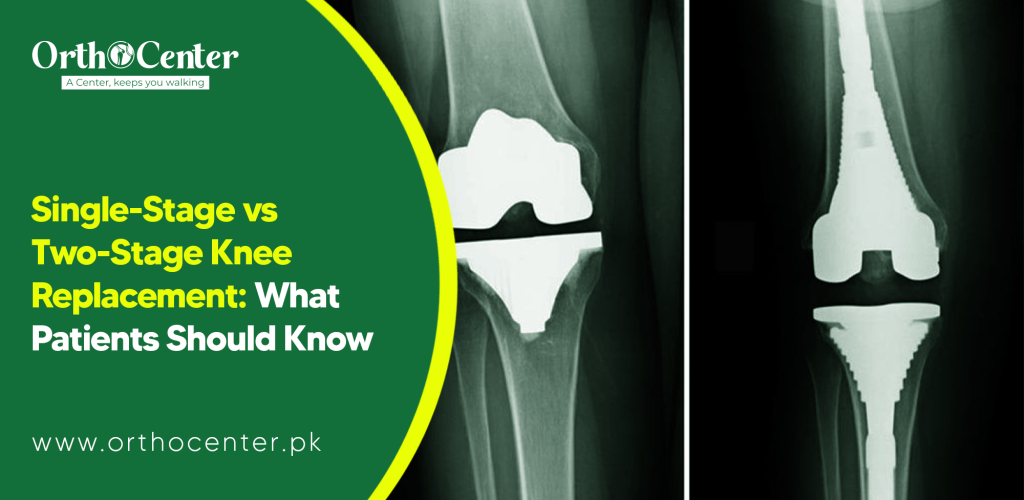
Knee issues tend to be part of growing older, injury, and living an extremely active life. Knee replacement surgery is a highly effective way to provide relief from pain and freedom of movement to countless patients. However, things tend to get quite puzzling when complications such as infections or failed implants enter the equation—that’s where patients begin to show concerns.
Experts in such cases usually prescribe patients one of two options: one-stage or two-stage knee replacement. A clear understanding of what patients can expect in terms of the specifics of each type of surgery and who might be better off undergoing one instead of the other can make all the difference.
A skilled orthopedic surgeon like Dr Ahmed Shoaib at Orthocenter realizes the significance of this awareness. He is regarded among his patients because he ensures the patient’s mental well-being, along with physical wellness, by discussing all aspects of options.
This blog aspires to help patients identify what they need to know about one-stage vs. two-stage knee replacement.

A knee joint has immense significance due to its contribution to almost all kinds of body movements. Knee arthroplasty or knee replacement is an invasive procedure that aims to remove damaged joints and placement of an artificial component. These man-made components are usually manufactured using metal, ceramic or plastic. As per the patient’s need, knee replacement can be performed in two ways.
As is evident from the name, total knee replacement surgery involves a complete replacement of the knee. It is performed when the knee is wholly damaged or diseased and is known as complete arthroplasty. Hence, patients who have severe arthritis, knee injuries or feeling pain and restricted mobility are more likely to have the surgery.
If the knee of the patient is partly damaged or has a disease, PKR is considered to be the least invasive method, which is a surgery where only a part of the knee is replaced with artificial material by surgeons. Thus, partial knee replacement works well if the patient is in moderate restrictions on movement, has mild pain, and if their knee structure is considerably intact.
Knee replacement surgeries have come a long way over the decades, with the revision methods constantly upgrading. The primary objective of these advances is to provide improved results for the patient. Among the methods for revision or replacement of the knee joint, single and two-stage approaches stand out. Yet there could be doubts about the procedure, suitability and efficacy. Here is a comparison that can eliminate confusion, and patients can confidently pick the right one for themselves.
When a patient has a failed or infected knee implant, there is a need for a revision procedure. If a person satisfies certain requirements that permit safe removal and replacement in a single procedure, a one-stage knee replacement is required. It is usually taken into consideration when the patient has good general health and immune state, healthy surrounding soft tissue, limited bone loss, and no active systemic infection. In such circumstances, surgeons go for one-stage or single-stage knee replacement to prevent multiple surgeries and facilitate a quicker recovery.
For every patient, understanding of the procedure matters a lot. A single-stage knee replacement, in simple words, is everything in one operation. Surgeons eliminate the infected implant and cleanse all the infection or damaged tissue. After getting satisfied with the internal condition, they place a new implant in the same session. Due to this approach, a definitive reconstruction is possible in one operation. Consequently, the need for multiple surgeries reduces, and earlier rehabilitation becomes possible.
Since all is carried out within a single shift during single-stage knee replacement, recovery from it is rather faster. Patients normally get a chance to undertake physiotherapy and weight-bearing exercises shortly after surgery. So, due to this surgical approach, knee function and strength are regained early. The Clinic stay is normally shorter, making the entire period of rehabilitation shorter. Everything mentioned above allows patients to resume their everyday life sooner.
In general, the overall expense of a one-stage knee replacement remains less than that for a two-stage procedure. The reason is that only one operation is performed, with a single hospitalization and a shorter treatment period. The patients have to pay once for hospitalization, anesthesia, medication, and other things. Furthermore, fewer follow-up procedures and rapid recovery may potentially reduce indirect costs.
According to estimations, the knee replacement surgery cost may range from PKR 400,000 to over PKR 1,500,000, depending on factors such as the type of procedure, implant brand, and hospital package.
Two-stage replacement is the requirement in the scenario when the failure of the previous prosthesis takes place due to infection, which cannot be treated safely in one surgery. The reasons when it becomes an absolute necessity include unknown or antibiotic-resistant bacteria causing the infection, the possibility of extensive bone loss and poor condition of the soft tissue, as well as the immunocompromised state of the patient.
As evident from the name, the two-stage knee replacement comprises two clearly defined phases. The purpose of each is to effectively eliminate infection and restore knee function. These stages require two separate surgical sessions. The aim of Knee Replacement Surgeons for separate sessions is to guarantee patient safety and long-term success of the revision surgery.
For many patients to recover from a two-stage knee replacement is typically more challenging. The reason is the involvement of the two surgeries. During the initial stage, the patient may have limited mobility due to the temporarily implanted spacer. Moreover, during this tenure, antibiotics are continually administered. However, once the second surgery is completed, the patient can recover and experience relief from the pain with the help of physiotherapy.
It is quite evident that doing major surgeries twice is going to be more expensive than doing them once. This is due to the fact that numerous hospital stays, the usage of antibiotics, and rehabilitation all add to the process’s high cost. Furthermore, indirect costs from time away from work and longer overall recovery also raise the budget. According to a rough estimation, the overall expense of the procedure may range from PKR 1.5 million to 2 million.
Overcome mobility challenges with expert care from Dr Ahmed Shoaib
Indeed, both single-stage and two-stage knee replacement are high-impact procedures that make patients hopeful about the restoration of mobility. Yet, the selection of any one of these is not simple. The choice is highly dependent on some factors. Knowledge of these factors helps in ensuring that the surgical procedure adopted is safe and most effective for the patient. These are;
| Aspect | Single-stage Knee Replacement | Two-stage Knee Replacement |
|---|---|---|
| Candidates | Patients with a damaged knee or infection in their joint, but in overall good health status. | Patients with severe infection or damage in their joints, but with a weak immune system. |
| Procedure involves | Removal of damaged artificial joints, cleansing of infections and placement of new artificial joints at once. | Two phases: one for the removal of the implant. Second is for the placement of a new implant. |
| Recovery | Shorter with less number of complications and a shorter hospital stay. | Longer and sometimes challenging, with frequent and longer hospital admissions. |
| Cost | PKR 400,000 – 1,500,000 | 1.5 million - 2 million |
To sum up, knee replacement procedures are high-impact methods that provide effective solutions for patients requiring reconstruction to restore mobility. In case of infection or damage to the implant after the first replacement. One-stage and two-stage knee replacements are a light of hope. So, when it comes down to it, there’s no single “right” answer in the debate between one-stage vs two-stage knee replacement. Each approach has its place.
A single-stage knee replacement describes one operation, shorter hospitalization, and a faster return to normal day-to-day activities is appealing for the correctly selected patients. In the meantime, the two-stage option is still significantly safer for the more challenging cases when infection control is important.
What is more important is to tailor the procedure to the patient, considering general health, knee status, and the ultimate recovery goals of the patient, so that the best outcomes can be yielded by whatever approach is used.
Dr Ahmed Shoaib at Orthocenter can make all the difference to each stage. He is uncompromising in providing patients with the best care and standardized procedures to prevent further revision surgeries. Thus, up-to-date facilities at Orthocenter and Dr Ahmed’s expertise can make your mobility restoration journey convenient and fruitful.
WhatsApp Us
